
An architectural jewel from 1879
Built at the behest of King Carol I as the gateway to the royal family's summer residence, the Royal Station of Sinaia is one of the most beautiful period railway stations in Romania. Every stone tells a story — of royal passages, of Austria-Hungary, and of the mountain that enchanted Romania's monarchs.
The building interweaves Art Nouveau elegance with the solidity of mountain architecture, offering today the same visual spectacle it presented to King Carol I on his first arrival in Sinaia aboard the royal train, in the last decade of the 19th century.
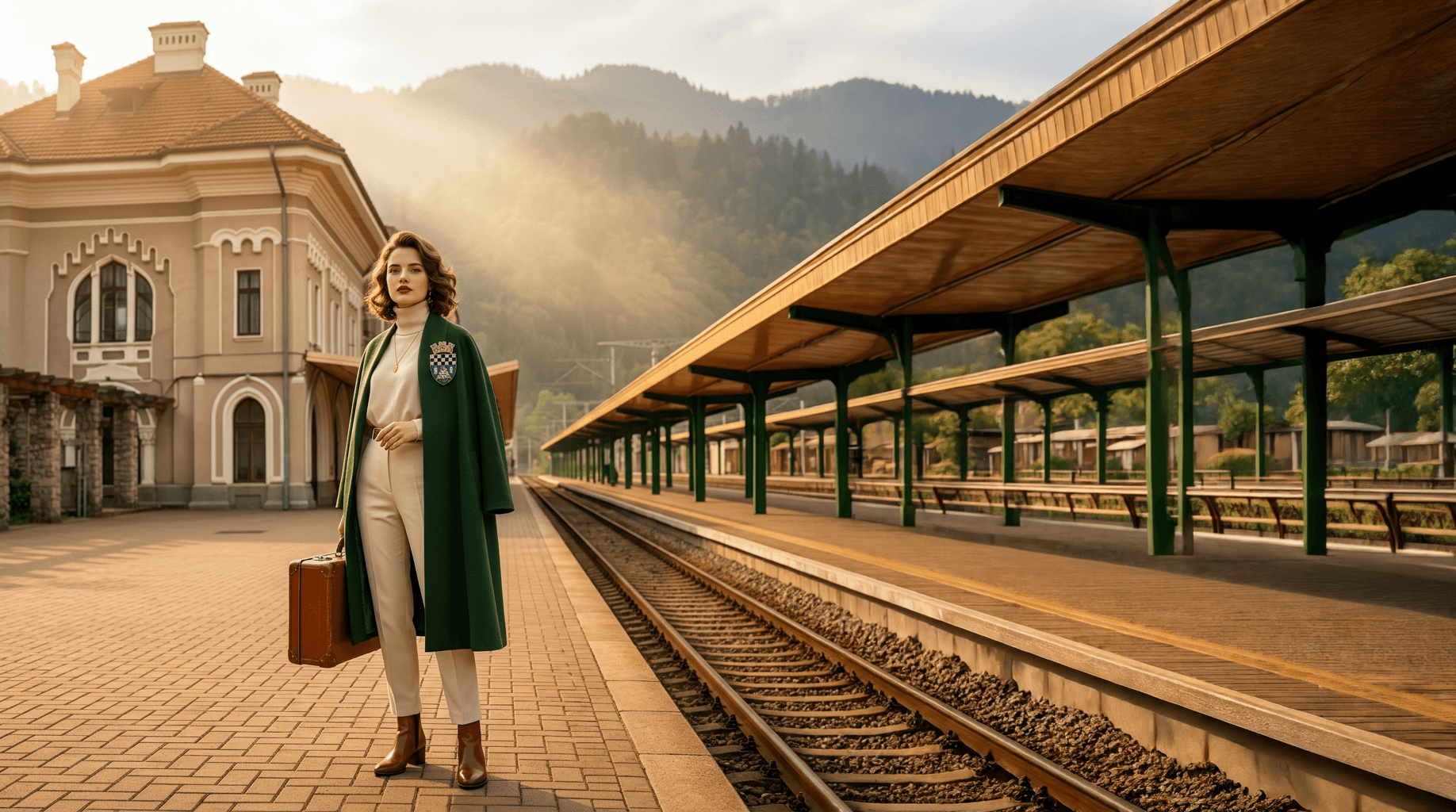
The Railway to the Royal Mountain
The Ploiești–Predeal railway line was completed in 1879, bringing with it the Sinaia station. King Carol I, a passionate admirer of mountains and modern infrastructure, personally insisted on the elegance of the station that would be the face of the kingdom to the world.
The royal waiting hall — accessible only to the Hohenzollern family and state guests — remained intact for decades, with its original furniture and period ornaments. The royal train periodically brought entire suites of ministers, ambassadors and relatives of European royal houses, turning the platform into a stage for 19th-century diplomacy.
"There is a small platform, at the mountain end of the station, where hurried passers-by never reach. There, if you stay silent and listen, you can feel the echo of the cast-iron wheels of the royal train."
Few know that beneath the station's eastern staircase there is a small chamber — the former telegraph correspondence room — through which King Carol I's coded messages travelled between Sinaia and the Royal Palace in Bucharest. Today the room is walled up, but the frame of the original window is still visible on the exterior wall, marked by a rose sculpted in stone.
Local legend says that on misty autumn days, when morning trains cut through the fog of the Prahova Valley, the shadows of royal passengers can still be seen projected on the old platform — a scenography that the station's anonymous architect designed on purpose, orienting the royal hall's windows to the east so that the first light of day would always belong to the king.
Art Nouveau in Mountain Stone
The station's façade combines Art Nouveau elements — organic curves, floral ornaments — with the solidity typical of mountain constructions built from Sinaia stone. The tall roof, with wide eaves reminiscent of Alpine architecture, was conceived for practical reasons: the abundant snows of Bucegi had to slide far from the platform.
The interior waiting hall preserves its ceiling with exposed oak beams and sculpted panelling, elements partially restored in CFR's recent rehabilitation works. The clock on the façade — the original mechanism, not a digital replica — continues to strike the hours with the same three chimes that King Carol I once heard.